When someone mentions Dungeons & Dragons, one may think of a group of nerdy fellows donning fake elf ears and capes, gathering around a table to speak in funny voices and roll dice. While I can say that most of that is true, something is missing from this scenario — the storytelling!
Dungeons & Dragons (often shortened to D&D) is a tabletop role-playing game where players create characters and work together to tell an epic story. Think of it as collaborative storytelling mixed with improvisational theater, strategy and problem solving.
Instead of a board like a traditional board game or a fixed script like a movie, the world unfolds in real time through imagination. You might explore ancient ruins, negotiate with dragons, uncover mysterious plots or even set a tavern on fire (trust me, it happens). None of these things actually happen, but they are told and shared like stories around a campfire.
How Does It Work?
D&D is played in a group, typically with three to six players and one Dungeon Master (DM). The players control individual characters within the story, while the DM controls everything else in the world. Traditionally, most D&D games follow this flow:
The DM describes the setting.
Players say what their characters want to do.
Dice are rolled to determine the success or failure of those actions.
The story continues based on the results of those rolls.
What to climb a castle wall? Roll for it! Trying to persuade your way past the guard? Roll for it! Attempting a handstand? Roll for it!
What's a DM?
For a D&D group to work, there must be players. There must also be someone who acts as the group’s compass. This person is called a Dungeon Master (DM). The DM is the group’s storyteller, the referee of player decisions and the world-builder for the setting the players explore.
The role of a DM is no easy feat. It requires someone dedicated to telling a story while advocating for the players’ choices. Such a pivotal role requires a few things. A DM must:
Create and run the adventure.
Describe the world and its inhabitants.
Play all nonplayer characters (NPCs), monsters and more.
Interpret the rules.
Determine outcomes.
The DM acts as part narrator, part game runner and the glue that holds everything together. But it’s important to know that a great DM doesn’t control the story — they guide it. The players’ choices should always come first in shaping what happens next.
What Supplies Do You Need?
So, you have a group of interested players, and someone who wants to be a DM. What’s next?
Dice
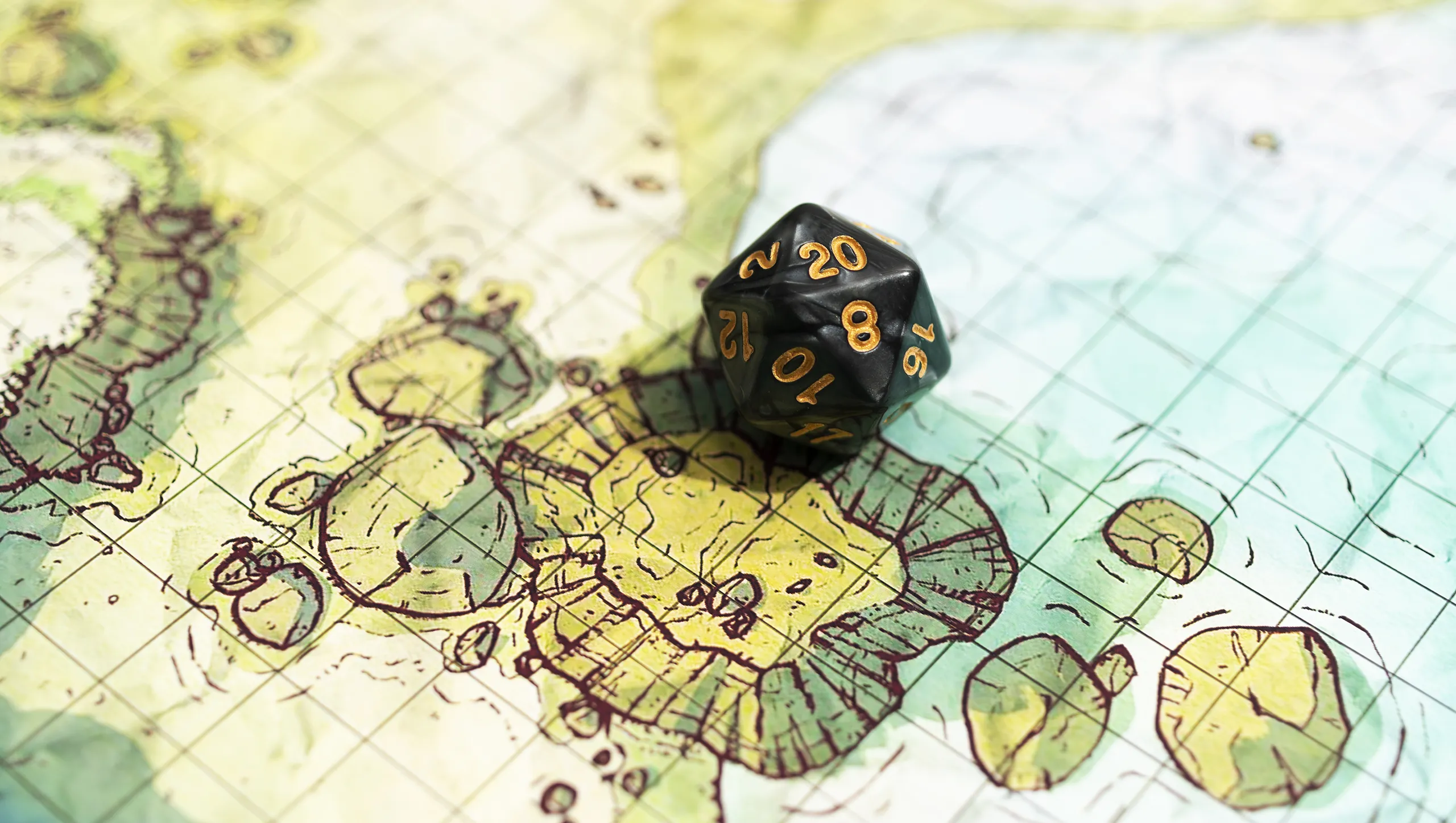
The d20 will be the most-used die for both players and DMs, but a 20-sided die is just one of many used in the game. Typically, the number of sides is associated with the amount of damage an attack can deal or the effectiveness of a skill. We D&D nerds name dice using the number being rolled followed by the number of sides. For example, if I’m rolling three six-sided dice, I’d say 3d6.
Character Sheets
A character sheet helps players keep track of their character’s stats, abilities and gear. It contains information about their race and class (more on that below), as well as their health, skills, languages and more. It’s a handy reference guide that reminds players who their character is and what they can do.
Rulebooks
While you can find most of what you need to create a character and play D&D online, it’s helpful for your group to have at least one copy of the “big three” (which you can find at your local library).
Player’s Handbook: Contains everything a player needs to create a character, learn the rules and begin playing (also includes advanced play techniques).
Dungeon Master’s Guide: Covers world-building, treasure tables, optional rules and advice for running adventures.
Monster Manual: Includes the stats, health and moves of the core creatures that inhabit the worlds of D&D. It helps DMs build balanced encounters by showing how much health and how many attacks a creature has, as well as its abilities and skills.
So, you have your players, your DM, your dice and your supplies. What now? It’s time to bring your character to life.
Creating a character is simple with the Player’s Handbook, which provides a step-by-step guide. The two most important choices you’ll make are your race and class:
Race: Fantasy worlds are filled with all kinds of creatures, and many of them can become your character. You can be a human, elf, dwarf, gnome, halfling and more. With a confident DM, you can be almost anything. Ever wanted to be a literal turtle person? (Stand back, Leonardo.) You can do that! How about a giant brute made of metal? You can do that, too! The sky’s the limit.
Class: Your class determines what your character does best. There are 12 core classes in D&D, each with its own strengths and weaknesses. Wizards, for instance, wield powerful magic but aren’t known for hand-to-hand combat. Barbarians, on the other hand, excel in strength and toughness, though they generally aren’t the best spellcasters or the smartest person in the room.
How to Play
Once the characters have been created and the DM has chosen a setting, the game can begin. The game is played in a few simple steps:
The DM describes the setting, situation, NPCs and creatures.
The players explain what they want to do.
The DM chooses the type of roll the player should make to determine the outcome.
It’s that easy! This three-step process applies to roleplaying (RPing) and just about everything else you do in the game.
Dice rolling, specifically with a d20, is used for most skill checks in the game. A 20, as explained earlier, is a critical success. A one? That’s a critical failure, which means something bad will likely happen. The difficulty of a check, or more importantly, the number to beat, is determined by the DM. Cracking an egg is much easier than lifting and throwing a massive boulder. Both are possible, but one requires more strength than the other.
In any adventure, you’ll face challenges, puzzles, and battles that test your determination and teamwork. A good story means you’ll grow, just as your character will. Learn from your mistakes and overcome the enemies standing in your way. All it takes is a few supplies, a passion for storytelling and a group of friends. Roll on!
Libby Update: Beginning October 13, Libby will require your library account password. Need to reset yours? If you have an email attached to your library account, click the button. Otherwise, visit your local branch for help.